Over the last two years, the way people search has fundamentally changed. Increasingly, users ask their questions not only in Google, but directly in ChatGPT, Google AI Overviews, or Perplexity — and they get the answer right there, without clicking through to any website. This is where a new discipline emerges: AEO (Answer Engine Optimization). In this article we'll cover what AEO is, how it differs from classic SEO optimization, and how to get your business cited in AI answers.
What Is AEO and How It Differs from SEO
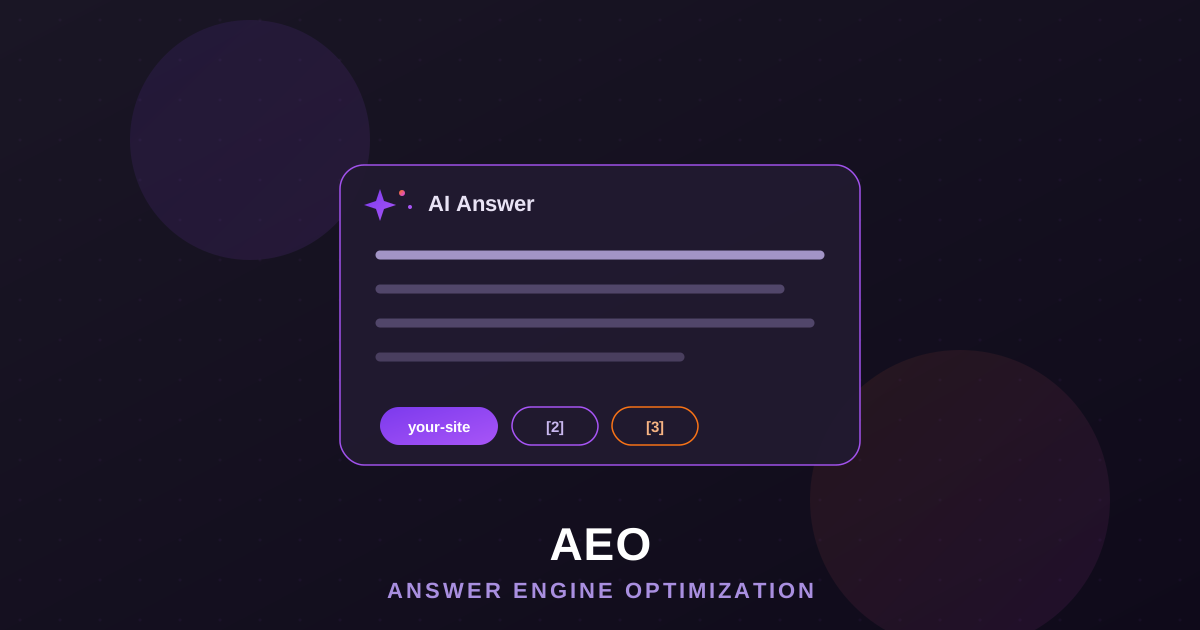
AEO (Answer Engine Optimization) is the process of preparing your content so it gets used and cited within answers generated by artificial intelligence. While classic SEO aimed to land you on the first page of Google results, AEO aims to get you into the answer itself — into the paragraph the AI writes — as a trusted source.
It's important to understand: AEO doesn't replace SEO — it extends it. Studies show a 92% correlation between pages ranking in Google's organic top 10 and pages cited in AI Overviews. In other words, AI mostly cites sites that already rank well. A strong SEO foundation is therefore a prerequisite for AEO, not an alternative to it.
Why SEO Alone Is No Longer Enough — The 2026 Numbers
The scale of the shift is clear in the data. As of 2026, Google AI Overviews appear on roughly half of all search queries (about 48% in March, up from around 34% a year earlier). ChatGPT has over 800 million monthly users, and ChatGPT Search processes 250–500 million queries per week.
At the same time, so-called "zero-click" searches — searches that end without a click to any website — reached around 65% in 2026. In practice, this means the user gets their answer directly in the AI block and, in many cases, never reaches a website at all. For brands, what matters is no longer just showing a link, but being mentioned and cited inside the answer itself.
The conclusion is simple: if your business doesn't appear in AI answers, you lose visibility at exactly the moment a potential customer is making a decision.
How AI Search Works — Overviews, ChatGPT and Perplexity
AI answer engines differ, and each has its own logic. Google AI Overviews favor content already in the organic top 10. ChatGPT leans toward authoritative, long-form, well-structured material. Perplexity especially values fresh, well-cited articles.
The shared principle is the same: AI looks for specific, factual, easily extractable answers. The model pulls an individual paragraph or sentence from your text that directly answers the user's question. So your content should be built so that every section delivers a complete, clear answer on its own.
Practical AEO Steps
1. Answer-first content. Start with a clear question (as an H2 heading) and immediately give a short, direct answer in the first 1–2 sentences. Then expand with detail. This "inverted pyramid" structure makes it easy for AI to extract your answer. Use a question-and-answer (FAQ) format and clear, short paragraphs.
2. Structured data (Schema). Add Schema markup — especially FAQ, HowTo, and Article types. According to Semrush, pages with FAQ schema are about 60% more likely to be featured in AI Overviews. Structured data helps AI correctly understand what your content is about.
3. Citable facts and statistics. AI prefers content that contains concrete numbers and sources. A good rule is one specific data point or statistic with a citation every 150–200 words. Research shows that adding an expert quote raises AI visibility by about 41%, while adding statistics and citations adds roughly another 30%.
4. Authority and brand mentions (E-E-A-T). AI trusts brands that are mentioned across many credible sources. Demonstrate expertise, experience and trustworthiness — author pages, real case studies, third-party mentions. Presence on platforms like Wikipedia and industry directories matters too, as AI frequently draws information from them.
5. Content freshness. AI models favor new and updated content. Observations show that AI-cited pages tend to be fresher, and citations gradually fade after about 13 weeks if the material isn't refreshed. Regular content marketing and updating articles is therefore an essential part of AEO.
6. Technical foundation. Since AI Overviews mostly cite top-10 pages, classic technical SEO — site speed, mobile optimization, clean structure, and indexability — is essential for AEO too. AI can't cite what it can't read.
AEO for Georgian Businesses
In the Georgian market, AEO is still a new discipline — and that's precisely the opportunity. While most competitors think only about classic SEO, moving early toward AI visibility creates a serious advantage. Content built around local questions, written in Georgian, and offering concrete answers is especially effective.
A practical tip: start by listing the most common questions in your field and prepare a clear, fact-based answer for each. That material becomes the foundation AI uses when generating its answers.
SEO and AEO Work Together
AEO doesn't replace SEO — they are two sides of one strategy. SEO makes sure your site is visible in search; AEO makes sure it lands in the answer itself. You can read more about the role of AI in our article on Artificial Intelligence in Business.
If you want your business to be visible both in Google search and in AI answers, the Digital Studio team can help you build a unified SEO + AEO strategy — from keyword research to structured data and citable content.